March 2025 - July 2026
€250,000


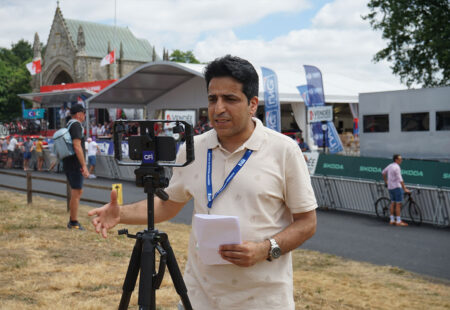
A Syrian journalist and France 24 correspondent in Damascus, Dana Alboz left Syria in 2013 before returning after the fall of the Assad regime. Drawing on both her personal memories and professional commitment, she paints a picture of a country in transition and the immense challenges facing its media. To tackle these challenges, she is counting on the support of programmes such as Kalam Min Souria.
I think we always leave a part of our soul in our country of origin. When I returned, I felt as though I was rediscovering something I’d left behind. It wasn’t a straightforward return… I was 19 when I left Syria; today, no one in my family lives there any more – they’re scattered across France, Germany and elsewhere. Coming back felt both familiar and extremely strange.
Before the regime fell, it wasn’t even conceivable. I was working on sensitive issues; I was critical of the government… Then everything changed dramatically. I was in Jordan when the regime fell. I remember opening a map on my smartphone and realising that Damascus was only a few hours’ drive away. I took about ten days’ leave and went there. Even today, I can’t quite put those ten days into words. I just know that I witnessed a historic period. That moment was decisive: I realised I had to be there, on the ground, to report on what was unfolding.
There is a new-found freedom, but also a huge void. For decades, independent journalism was virtually non-existent. Today, everything needs to be rebuilt: practices, impulses, the culture of debate. Journalists must relearn how to investigate, to question, to criticise. And that takes time.
The situation remains extremely delicate. There is still violence, regional tensions and constant instability. And then there is the challenge of complexity: after fourteen years of war, nothing is simple. We must avoid oversimplification and understand local dynamics and individual stories. Reporting here requires great rigour.
Working on the ground, in your own country, changes everything. There is a very strong emotional dimension, but also a greater sense of responsibility. I’m covering situations that I know intimately, whilst maintaining the necessary distance.
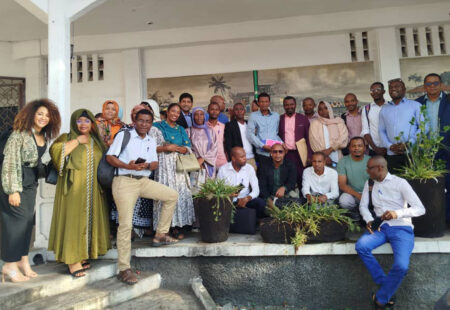
Because it meets an urgent need. Launched in March 2025, its stated aim is to support Syrian media professionals in order to strengthen their ability to report, document and participate in public debate in the context of Syria’s political transition. Right from the very first sessions, we brought together journalists from a wide variety of backgrounds, as well as students. We worked on the fundamentals (the role of journalism, its link to democracy) but also on practical tools, such as fact-checking.
It helps to rebuild connections and pass on skills. In Syria, social media has become a major source of information, with all the risks that this entails. Training journalists to verify content and provide context is essential to prevent abuses.
That is, in fact, one of its key strengths. During the first sessions, journalists from different generations and regions were able to share their experiences. These exchanges are invaluable: they provide a better understanding of the realities on the ground and help build a collective vision.
They are essential. There is genuine synergy between the stakeholders: training, support, and the production of tailored content, particularly for social media. The Beirut hub, for example, enables us to develop new formats whilst adhering to journalistic standards. An ecosystem is taking shape.
It’s been an extraordinarily enriching experience. It’s a kind of full circle: I was a journalism student in Damascus, and now I’m returning to engage with young journalists. But it’s also a constant learning process. I’m learning a great deal from those who have stayed behind – from their resilience and their commitment.
There is a huge need for support. Journalism must be part of the country’s reconstruction. For democracy to emerge, we need media organisations capable of investigating, questioning those in power and letting citizens be heard. This is essential to make Syrians heard – both men and women – who have been isolated for so long. There’s a lot that remains to be done. The energy and determination to do it are already there.
I’d like to continue chronicling this transition, with nuance and honesty. To show the complexity of Syria today, not the clichés.
A project
Supported by
In partnership with